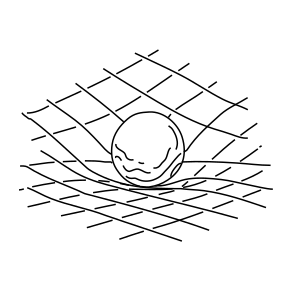
Gravity well diagram

In particular, I’m interested in general relativity and the consequences of gravitational waves. Namely, how do we make sense of measurement while swimming in a sea of these ripples? More broadly, I’m interested in fundamental physics as a way of approaching deep ontological questions about what exists and what can be observed.


Rotated disks about a curve used to illustrate nonlocal curvature

My current research is in nonlocal analysis and geometric measure theory. I study a notion of curvature that takes into account nonlocal effects. The aim of the research is to show that this nonlocal notion recovers classical local curvature in an appropriate limit.

Specifically, the notion of nonlocal curvature of a curve that I study is

Definition of the nonlocal curvature vector kappa sigma at z

Here A even of z and A odd of z are triplets a, b, and r parameterizing disks centered at z plus r a, with normal b and with radius r, whose boundary contain z and intersect the curve an even and odd number of times respectively. Additionally, principal value denotes the Cauchy principal value with respect to radii, and H to the two n minus two is the two n minus two-dimensional Hausdorff measure.

I’ve carried out the calculations, developed the estimates, and written the manuscript under faculty guidance. The project has required algebratizing geometric intuition and using pertubative analysis for the limiting argument.

A manuscript is in progress.

Loyola University Chicago Loyola University Chicago

I earned an M.S. in Mathematics from Loyola University Chicago in Spring 2025, after completing a B.S. in Theoretical Physics and Applied Mathematics there in Spring 2015.

My undergraduate work began with physics. I loved the subject and enjoyed exploring it with mathematical tools. Philosophy was part of that same education, through the honors program, and it taught me to handle concepts carefully, notice the assumptions built into language, and ask what kind of explanation a theory is actually giving.

The master’s degree marked a deliberate re-entry into academic work and helped me develop a more mature proof-based foundation.

Histogram of supernova type classifications

My earlier research experience was in observational cosmology. At Argonne National Laboratory, I studied contamination in photometrically selected Type Ia supernova samples using simulation and light-curve classification tools.

That project gave me an early view of research as a collaborative practice. I worked with existing scientific software, interpreted imperfect data, and refined a classification procedure until it answered the physical question more cleanly. The 2015 AAS session poster and supporting analysis code are available online.